Callables in Modern C++
Overview
A Callable is any entity that can be invoked with parentheses ().
C++ provides multiple mechanisms for representing and using callables, from raw
function pointers to high-level polymorphic wrappers like std::function.
Callables unify functions, objects, and expressions that perform actions. Understanding their differences is crucial for writing generic and flexible code, especially when working with the STL, callbacks, or modern functional-style programming.
Note
In generic programming, callables allow code to treat functions, lambdas,
and functors uniformly through template type deduction or std::invoke.
Types of Callables
C++ supports several categories of callables:
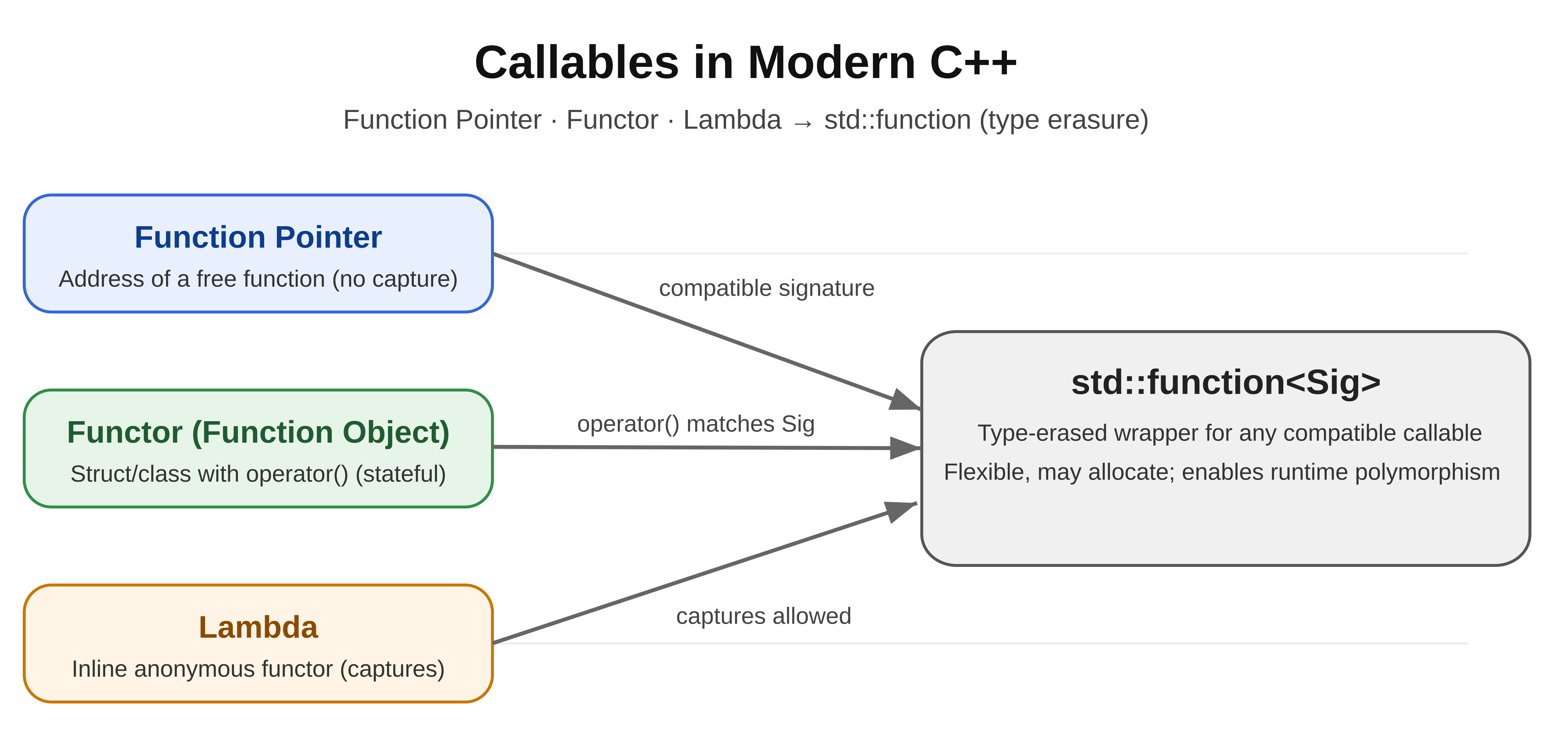
Function pointers — addresses of free functions.
Functors (function objects) — structs or classes that overload
operator().Lambdas — unnamed function objects defined inline.
std::function — a type-erased wrapper for any callable with a compatible signature.
Quick Comparison
Callable Type |
Captures State? |
Overhead |
Typical Use |
|---|---|---|---|
Function pointer |
No |
None |
Callbacks; C APIs |
Functor |
Yes |
None |
STL algorithms |
Lambda |
Yes |
Minimal |
Inline logic |
|
Yes (erased) |
Possible heap |
Generic storage |
Detailed Topics
The following sections explore each callable category in detail:
Interoperability
All callable types can be used with std::invoke and std::is_invocable to
determine at compile time whether they can be called with specific arguments.
Example
#include <functional>
#include <iostream>

int add(int a, int b) { return a + b; }

struct Multiplier {
  int factor;
  int operator()(int x) const { return x * factor; }
};

int main() {
  auto lambda = [](int x) { return x * 3; };
  std::function<int(int)> generic;

  generic = add;                 // Function pointer
  std::cout << generic(2, 3) << "\\n"; // 5

  generic = Multiplier{4};       // Functor
  std::cout << generic(5) << "\\n";    // 20

  generic = lambda;              // Lambda
  std::cout << generic(6) << "\\n";    // 18
}
Tip
Prefer lambdas for inline, short-lived operations. Use std::function when
the callable must be stored, passed around, or reassigned dynamically.
Summary
Function pointers are the most lightweight but least flexible.
Functors offer state and are ideal for STL algorithms.
Lambdas provide concise syntax for local or temporary callables.
``std::function`` generalizes callables through runtime type erasure.
Understanding these options helps you design APIs that are both efficient and expressive.